
Protect Your Peace: 12 Ways That Actually Work
Learning to protect your peace is not a luxury — it is a survival skill for anyone trying to live a grounded, intentional life in a world designed to saturate and destabilize. I learned this the hard way. Last March I was in deep. Overwhelmed and oversaturated with information, opinions, feelings, and obligations. Usually I love to feel and fix and share, but it was all too much. Our family escaped for a week and I resolved to put my phone away.
I had been entertaining so many thoughts and ideas from so many people that I had lost touch with myself. As I disconnected, my own spirit, mind, and heart reemerged. I felt grounded, grateful, and capable again. And a constant refrain stayed in my mind: protect your peace. So I started figuring out exactly how. Here is what helped me — 12 ways to protect your peace that have brought genuine hope and stability back to my life.
12 Ways to Protect Your Peace
1. Choose Your News Sources Carefully — and Skip the Comments
Read news from trusted sources that inform without causing unnecessary contention — then stop. Do not read comments. No more letting Joe23572 ruin your entire morning. To protect your peace from the news cycle, you must decide what counts as enough information and where the line is between being informed and being consumed.
2. Do a Social Media Clean Out — Often
Your feed should work for you, not against you. Regularly unfollow or mute accounts that make you feel consistently worse — more anxious, more envious, more angry, more inadequate. If an account is making you miserable or fostering an unhealthy relationship with how you see your own life, it does not belong in your space. Protect your peace by treating your feed like your home: you get to decide what is welcome. For a practical guide, read our post on doing a full social media clean out.
3. Turn to a Small, Trusted Circle for Hard Questions
You do not need the entire internet’s opinion on every difficult or confusing issue in your life. Turn to a small group of trusted, respected people — people who are genuinely interested in listening, explaining, and learning, regardless of their own opinions. This does not mean living in an echo chamber; it means choosing your conversation partners thoughtfully. Protect your peace by being selective about who gets access to your uncertainty.
4. Seek the Good and Fill Your Life with Uplift
When life is heavy, balance it intentionally with hope. Actively look for beauty, goodness, and progress. Embrace it when you find it and share it freely. This is not toxic positivity — it is a deliberate counter-weight to everything difficult that demands your attention. To protect your peace, you must actively nourish the part of you that believes good things are real and worth celebrating.
5. Bring Hard Questions to God and Listen
For me personally, bringing my most difficult and confusing questions to God — and listening for answers that come in their own time and in their own way — has been one of the most reliable ways to protect my peace. Be okay when His answers look different from what you expected, or different from what others around you seem to receive. That difference is not a problem; it is part of the process.
6. Trust Your Own Capacity to Decide How You Feel
You are capable of deciding what you think about hard issues. You do not need to be a follower or jump on bandwagons. You can take as much time as you need to research, reflect, and understand. It is okay to be unsure of how you feel about something. It is okay to change your mind when new information comes. To protect your peace, claim your own intellectual and moral autonomy rather than outsourcing it to whoever is loudest.
7. You Do Not Have to Share Every Opinion Publicly
Your public voice is only one of many ways to support things that are important to you. Not every belief you hold requires a public statement. You can change your mind without announcing it. Doing so shows maturity and a willingness to learn. Protect your peace by resisting the pressure to perform your convictions online in ways that invite confrontation.
8. See the Good in People Who Believe Differently
This is one of the most important ways to protect your peace long-term: keep people in your life who think differently from you and seek to genuinely understand them. Not to debate them. Not to convert them. To understand them. The relationships that survive significant difference are some of the most nourishing ones you will have.
9. Release the Things You Cannot Fix
You do not have the capacity to care about or fix everything. You must let some things go and trust that other passionate, capable people are filling those needs. Everyone working on the things that matter most to them creates more change than any one person trying to hold everything. To protect your peace, give yourself permission to let certain things belong to others.
10. Refuse to Judge People on One Moment or One Quote
Choose to see people as feeling humans instead of unfeeling objects, and act accordingly. Remember how often you have required grace — how grateful you are not to be defined by your worst moments. Extend that same grace. Protect your peace by refusing to reduce people to their most quotable mistake.
11. Take Breaks from Input
It is not selfish to step away from the constant flow of information, opinion, and other people’s emotional lives. It is spirit-sustaining. You do not owe the world your constant attention. One of the most reliable ways to protect your peace is to regularly create silence — a day without the news, an evening without social media, a week where the phone goes away. The world will be fine without you for a bit. You will be better for the break.
12. Do Something Deliberate
Deliberate effort to make a difference daily erases hopelessness and helplessness. Who you decide to be each day matters. Never underestimate the power one person has to change the world in the small radius around them. When you are doing something — reaching out to one person, serving in your community, investing in your family — you feel useful and present in a way that protects your peace far better than any amount of scrolling or commenting ever will.
What Happened When I Learned to Protect My Peace
These 12 steps have brought genuine peace and hope back to my life and allowed me to seek the good even when the whole world feels unstable. It is not easy. But protecting your peace is a battle worth fighting — for yourself, for the people you love, and for the kind of parent and person you want to be.
It is not about checking out. It is about choosing deliberately what you check in to.
Related Reading
These posts from Brooke Romney Writes go hand in hand with this one:
- social media clean out — curate your feed
- how to reduce screen time for teens
- sincere compliments for teens that work
Helpful External Resources
Frequently Asked Questions: Protect Your Peace
What does it mean to protect your peace?
To protect your peace means to intentionally curate what you allow into your mind, heart, and daily life. It is not about avoiding hard things or living in a bubble. It is about recognizing that your mental and emotional bandwidth is finite and choosing deliberately what gets access to it rather than letting everything in by default.
How do you protect your peace from negativity?
Practical ways to protect your peace from negativity: read news from sources that inform without inflaming, unfollow or mute accounts that consistently make you feel worse, bring difficult questions to a small group of trusted people, take regular breaks from input, and do something concrete each day that matters to you. Treat your peace as something worth defending, not something that simply happens to you.
Why is protecting your peace important?
Protecting your peace is important because without it, your spirit, your judgment, and your capacity for genuine connection gradually erode. When you are constantly saturated with other people’s opinions and anxieties, you lose touch with what you actually think and feel. The people who protect their peace intentionally tend to be more present, more grounded, and more genuinely helpful to others than those who take in everything without a filter.
To see an interview I did on this subject, click the link HERE.
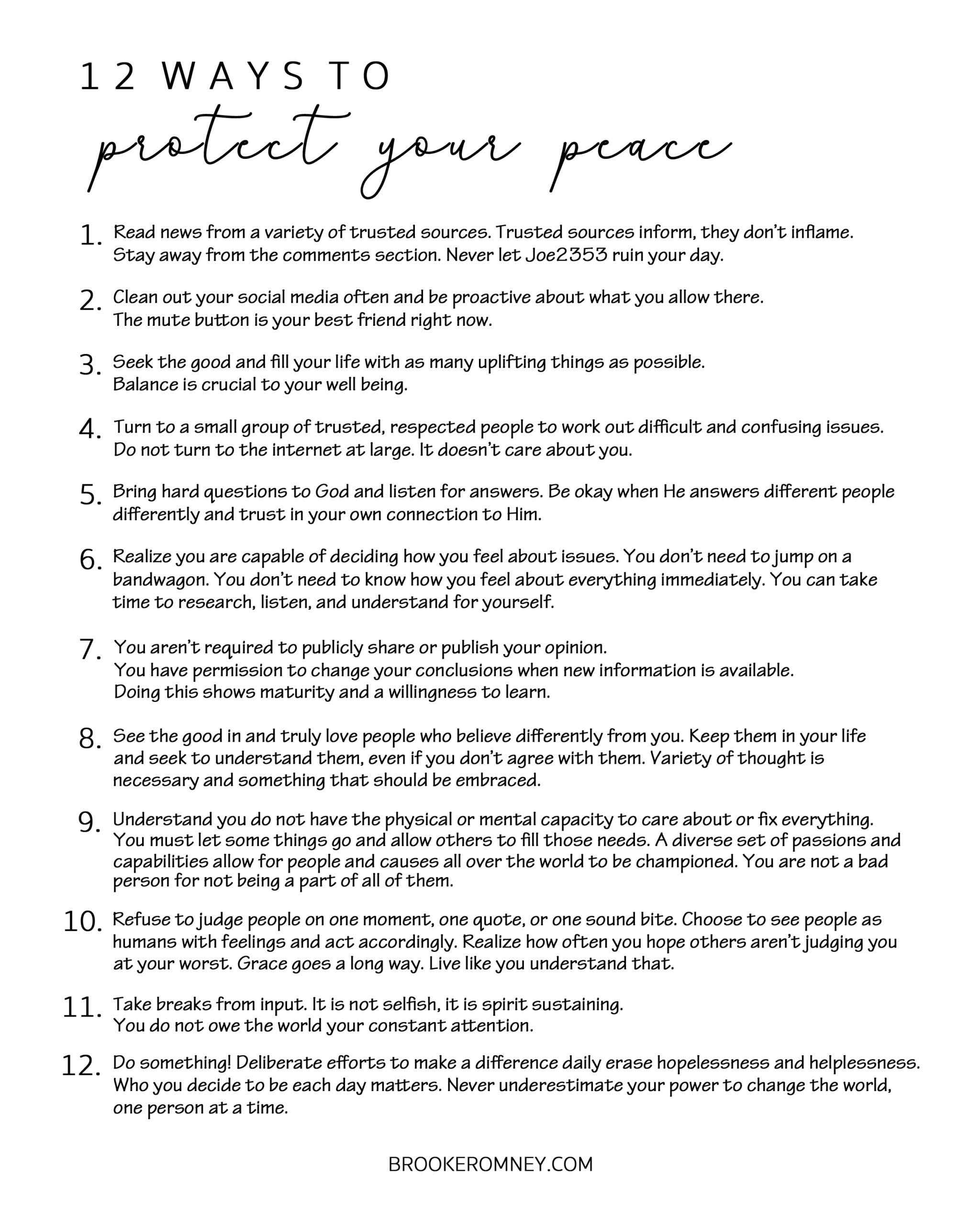
(You can save this image by right clicking and choosing to “save as.”)