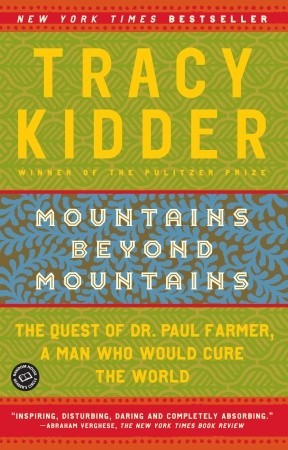
The book takes us from Harvard to Haiti, Peru, Cuba, and Russia as Farmer changes minds and practices through his dedication to the philosophy that “the only real nation is humanity” – a philosophy that is embodied in the small public charity he founded, Partners In Health. He enlists the help of the Gates Foundation, George Soros, the U.N.’s World Health Organization, and others in his quest to cure the world. At the heart of this book is the example of a life based on hope, and on an understanding of the truth of the Haitian proverb “Beyond mountains there are mountains”: as you solve one problem, another problem presents itself, and so you go on and try to solve that one too.
“The book unfolds with the force of a gathering revelation,” says Annie Dillard, and Jonathan Harr says, “[Farmer] wants to change the world. Certainly this luminous and powerful book will change the way you see it.”
Related Reading
Frequently Asked Questions: Mountains Beyond Mountains
Is Mountains Beyond Mountains hard to get into?
It takes a chapter or two, and then it takes off. That is worth knowing because the opening is the only slow part — once Kidder has you inside Paul Farmer’s world, the book reads like a novel rather than like non-fiction. Give it thirty or forty pages before you decide.
Is it too depressing?
It goes to genuinely difficult places — poverty, disease, and medical systems that fail the people who need them most — and it does not soften any of it. For readers sensitive to language or to sad but real situations, it may be too much. What balances it is that the book is fundamentally about someone refusing to accept those conditions.
Do I need a medical background to follow it?
Not at all. It is written for a general reader, and Kidder explains what you need as you go. The book is far more interested in Farmer as a person — his odd childhood, his convictions, his refusal to compromise — than in clinical detail.
What does the title mean?
It comes from a Haitian proverb: beyond mountains there are mountains. As you solve one problem, another presents itself, and so you go on and try to solve that one too. It is the whole thesis of the book in six words, and it reframes the story from a biography into an argument about how to spend a life.